
Why Author Ringo Beaumont Returned to the Story of Grace Marcuson
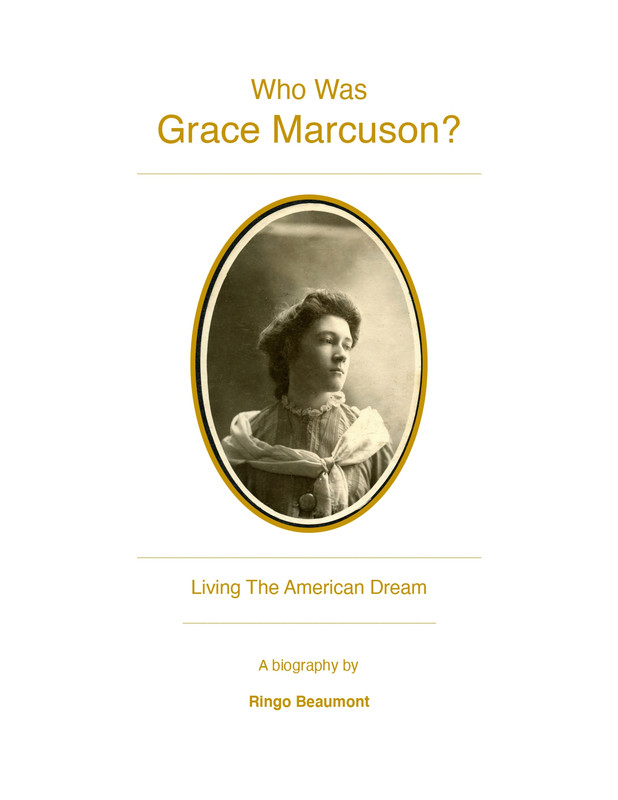
Most of the history we’re taught in school belongs to the loud. We learn about the generals who won the battles or the politicians who signed the treaties. But if you really think about it, countries aren’t built by a handful of famous people. They are built by the thousands of quiet individuals who stood their ground, raised their families, adapted to massive changes, and simply kept going.
That is the heart behind Who Was Grace Marcuson?, a biography by Ringo Beaumont. Now in its expanded third edition, this book turns the spotlight away from the household names and shines it on an “ordinary” woman who lived an extraordinary life of quiet resilience.
While most authors launch a book and move on to the next project, Ringo Beaumont could not just walk away from the story of Grace Marcuson. After publishing the initial history of this remarkable frontier woman, Beaumont realized there was still more to say. The result is the newly expanded third edition of Who Was Grace Marcuson? a project born out of a respect for a generation of women whose quiet resilience shaped America.
But why return to a story that was already told?
The Drive for a Fuller Picture
Writing a biography based on real, historical fragments is a massive puzzle. Grace Marcuson was an ordinary woman who lived through extraordinary times, from the Nebraska prairies and Idaho hills to the mining camps and citrus groves of Southern California.
Because she didn’t live her life in the public eye, her legacy was preserved the way most family histories are: in scattered diary entries, old letters, and dictated journals.
For the third edition, Beaumont wanted to give readers a much clearer, richer look into Grace’s world. This meant restructuring the narrative flow and expanding chapters to dig deeper into how her family navigated the massive shifts of the late 19th and early 20th centuries, including the local impacts of both World Wars, logging, and ranching. He wanted to sharpen the lens so her everyday courage could truly shine.
Bringing the Past Into Focus
Another major catalyst for this new edition was the visual history. Beaumont teamed up with Don Taylor Studios in Los Alamos, New Mexico, to restore a collection of old family photographs.
In a biography about an unsung figure, photos are proof of life. By significantly improving the photo quality for this release, the book allows readers to look directly into the eyes of the last survivor of two early-1800s emigrant families. It transforms abstract history into a deeply personal, visual journey.
An Engineer’s Precision, a Historian’s Heart
To understand why Beaumont spent so much time perfecting this single life story, you have to look at his own eclectic background. He has worked as a military aircraft mechanic, a nondestructive testing inspector for defense missiles and the space shuttle program, and an R&D engineer at a National Laboratory. He also holds a degree in mathematics with a double minor in history and political science (and has even moonlighted as a nightclub singer).
That combination of technical precision and empathy is exactly why he couldn’t leave the job half-done. An engineer doesn’t leave a project until it’s seamless, and a historian knows that the stories of “ordinary” people are the true foundation of national progress.
As Beaumont himself puts it: “Grace and her family were simply committed to living, adapting, and surviving, doing what needed to be done. That, in itself, is a legacy.”
By returning to her story, Beaumont has ensured that this legacy won’t be lost to time.