WHEN A DEAN WITH JEWISH ROOTS PAUL WARREN WALKS INTO A JESUIT UNIVERSITY: A MEMOIR OF PREJUDICE, POLITICS, AND UNEXPECTED GRACE
Paul Warren never expected that accepting a deanship at the University of San Francisco would force him to confront ghosts he’d been carrying since childhood. But sometimes the most profound personal growth happens in the least expected places, like a Catholic, Jesuit institution on the opposite coast from everything he knew.
For thirteen years, from 1989 to 2001, Warren served as Dean of the School of Education at University of San Francisco, meticulously documenting over six hundred anecdotes that would eventually become his memoir, University Follies: Jewish Roots in a Jesuit University. What emerges from these pages isn’t just another academic chronicle. It’s a profoundly human story about confronting our own prejudices and discovering connection across cultural divides.
The Weight of History
Warren arrived at USF carrying invisible baggage. Growing up in Greenwich Village in a liberal theatre family during the 1940s and ’50s, his childhood was relatively isolated from Catholics. His mother was an actress, his father an arts-appreciative dentist, and their world revolved around the progressive politics and social justice themes that permeated Village life. Then came the McCarthy era, when the Catholic Church’s support of Senator Joseph McCarthy inflicted real pain on his family and their friends in the arts, people whose livelihoods were threatened by blacklists and whose reputations were destroyed by innuendo. These experiences left traces of prejudice that Warren didn’t fully recognize until decades later.
His path to USF wasn’t straightforward. After his father died when he was fifteen, Warren’s world transformed overnight. From a private progressive school, he transitioned to an overcrowded New York City public high school, then to Princeton (much to his mother’s dismay), and then to substitute teaching that evolved into full-time work at a Hell’s Kitchen high school with predominantly Black and Puerto Rican students. A PhD from NYU, work in Brooklyn’s Ocean Hill-Brownsville District, and eventually a position at Boston University shaped his understanding of education and social change.
After years as professor and administrator at Boston University, following 8 years as Dean of the School of Education appointed by John Silber the controversial University President John Silber, differences with the president signaled it was time to leave. That’s when the USF opportunity emerged.
A New World
The University of San Francisco proved to be something altogether different. The situations Warren encountered ranged from the absurd to the profound. Staff decoration of a Christmas tree with condoms, requiring delicate navigation of competing values. Conflicts between professors and staff members threatened to escalate. Labor-management battles erupted with regularity. A pig barbecue for Multicultural Services Day ended with fire trucks, smoke, and chaos when someone forgot to get a permit from the fire department.
Through it all, Warren kept his log, capturing not just the events but the emotions and human dimensions that official university histories tend to gloss over. As one memorable passage illustrates: “It was only one week later when Father’s reference to Deuteronomy as a reference for the wisdom he was to share outperformed my citation of the Halakah. The School’s mission statement and undergirding programs, I’m afraid, still promised – all things to all people. Without a clear definition and priorities, marketing was hampered. With little prospect of budget increases, we risked being placed in a Procrustean bed in which all programs would be equally short, equally long, and equally dead.”
The Transformation
What makes University Follies remarkable isn’t just Warren’s honest accounting of challenges particular to university leadership. It’s his willingness to examine his own transformation. Through close working and social relationships with members of the Jesuit Community, something unexpected happened: “the ghosts of Catholic prejudice thawed.”
Warren came to understand that universities are fundamentally human institutions. Both positive and negative characteristics of human behavior regularly surface. Idiosyncrasies aren’t bugs in the system; they’re features of any organization populated by real people. The Jesuit administrators and professors, through their behaviors and relationships with Warren, sometimes helped address the long-standing personal religious prejudices he brought with him.
The memoir captures this evolution honestly. One particularly moving moment occurs during the inauguration mass for Father President Steve Privett SJ. As priests in white robes processed down the center aisle of St. Ignatius Church carrying portraits of six Jesuit martyrs slain in El Salvador, Warren found himself swept up in the mystery and humanity of the Catholic Mass. “I, a child of Jewish and Episcopalian parents, brought up in a home that questioned the existence of God, once a young man in a family in which Catholicism took a beating, now found myself wrapped in the mystery and humanity of this Catholic Mass.”
The Boulder and the Hill
Warren doesn’t shy away from the frustrations. He repeatedly uses the metaphor of Sisyphus pushing a boulder up a hill, only for it to roll back down. Faculty parking disputes derailed important program initiatives. A promising retreat in Marin County to discuss school reorganization descended into chaos as professors fought to protect their turf. His appointment of progressive educator Herb Kohl without a traditional doctorate sparked resistance from colleagues who saw it as a violation of protocol and union contract.
Yet there were victories too. A teacher named Nina, a slight white woman flourishing in a Bayview public school serving primarily poor Black students, demonstrated that good teaching transcends racial boundaries. Student Julia, bursting with enthusiasm for teaching, represented hope for urban schools. And in small moments, like rescuing a neglected goldfish named Birdy by convincing the staff assistant to buy a proper aquarium, Warren found evidence that his words could make a tangible difference.
A Legacy Documented in Real Time
When Warren retired and returned to Boston after thirteen years, he carried with him the words of the university provost’s farewell toast: “You have done irremediable good for the School and the University.” He wasn’t entirely confident in the validity of that assessment. But he was convinced of something more personal and perhaps more profound: his belief in the university as both a human institution and an academic one had been validated.
Published in 2024 after Warren retires from Vermont and nearly twenty-five years of university management experience, University Follies offers something increasingly rare: an honest, humorous, and ultimately hopeful account of overcoming prejudice through sustained human contact.
The California Bookwatch notes that the memoir “contains more than hindsight writing,” precisely because Warren was documenting events in real-time. This contemporaneous recording gives the book an immediacy and authenticity that retrospective memoirs often lack. We don’t just learn what happened. We experience what it felt like to navigate unfamiliar territory while confronting one’s own limitations.
As the Midwest Book Review concludes: “Readers interested in accounts of educational labor/management battles, dueling principles, the Jesuit ambience of the university Warren worked for, and the follies which emerged from the intersection of student, teacher and management concerns will find University Follies more than entertaining while it educates on challenges particular to university leadership.”
University Follies: Jewish Roots in a Jesuit University is a book about universities, but more fundamentally, it’s a book about humans: our capacity for prejudice, our potential for growth, and our ability to find connection in the most unexpected places. Progress may be slow. The boulder may need to roll back down the hill many times. But with patience, openness, and a willingness to document the follies along the way, transformation is possible.
Read, Remember, Act
University Follies: Jewish Roots in a Jesuit University offers far more than an insider’s view of academic politics. It’s a masterclass in navigating cultural differences, overcoming deep-seated biases, and finding common ground in the most unexpected places. Whether you’re connected to Jesuit education, fascinated by university life, interested in Jewish-Catholic relations, or simply love memoirs that combine humor with profound insight, Warren’s honest storytelling will resonate with you. With rave reviews from California Bookwatch and Midwest Book Review calling it “highly recommended” for its “lively story of ironic interactions and wry humor,” this is the university memoir you’ve never read before.
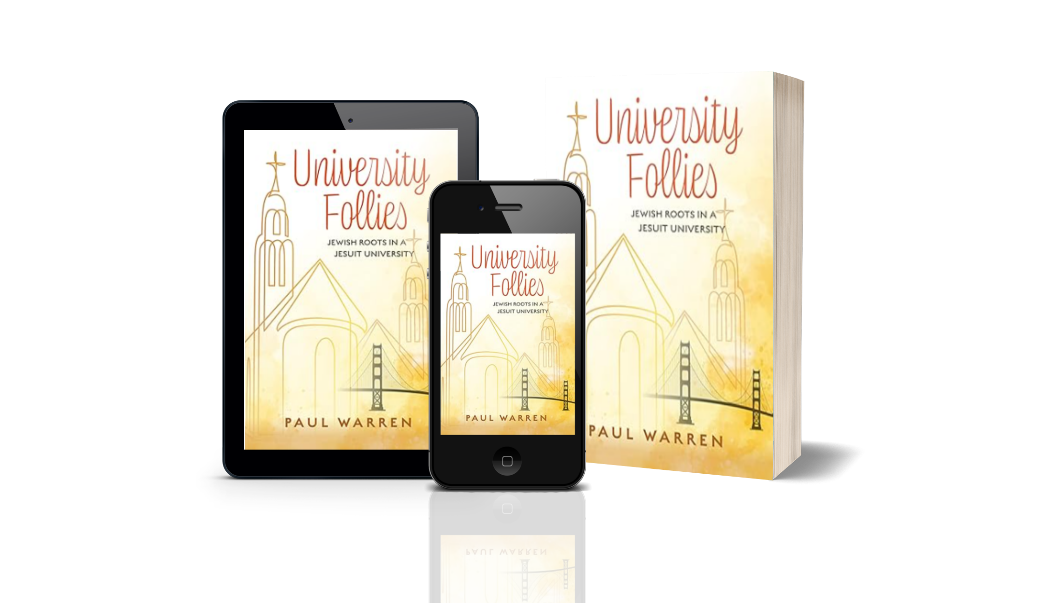
University Follies: Jewish Roots in a Jesuit University is available now in eBook and Paperback, on Amazon, Google Books, Book Baby, Barnes & Noble, Goodreads, and several other major digital platforms.
.jpg)