Dental Implant vs. Dental Bridge: How to Compare Your Options
A dental implant and a dental bridge can both replace a missing tooth, but they work differently. An implant uses a post placed in the jawbone to support a replacement tooth, while a traditional bridge fills the gap using neighbouring teeth for support. A dentist in Red Deer can help determine the better option based on your oral health, bone condition, adjacent teeth, treatment preferences, and budget.
What is the difference between a dental implant and a bridge?
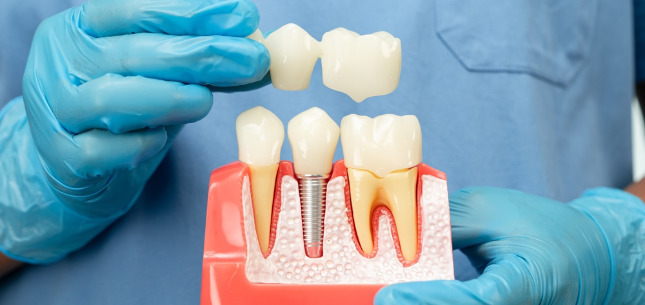
A dental implant replaces the root of a missing tooth with an artificial implant that supports a crown. A traditional dental bridge uses one or more artificial teeth supported by crowns attached to neighbouring teeth.
Both approaches can restore appearance and chewing function. Neither is automatically best for every patient.
Delta Dental offers dental implants in Red Deer and dental bridges, which are the relevant service pages for patients comparing these options.
Dental implant vs. bridge: Side-by-side comparison
| Factor | Dental implant | Traditional dental bridge |
| Main support | Implant placed in the jawbone | Supporting neighbouring teeth |
| Treatment process | Surgery and healing are usually involved | Often involves preparing supporting teeth and fitting a bridge |
| Neighbouring teeth | May not require preparation of adjacent teeth | Adjacent teeth usually need preparation |
| Bone considerations | Adequate bone and healthy tissues are important | Does not require an implant to be placed in the jaw |
| Treatment time | Often longer because healing is required | Often shorter, depending on the case |
| Maintenance | Daily cleaning around the restoration and professional follow-up | Cleaning under the bridge and around supporting teeth |
| Suitability | Depends on health, bone, anatomy, and other factors | Depends on the condition of supporting teeth and bite |
| Cost considerations | Surgery, implant components, restoration, and possible additional procedures | Supporting crowns, laboratory work, and complexity |
This table describes common differences. Actual treatment plans vary.
How does a dental implant work?
The dentist assesses the missing tooth site, gum health, bone volume, bite, and medical history. If an implant is appropriate, a titanium or other suitable implant system is placed in the jawbone.
During healing, the implant may integrate with the surrounding bone. Once the site is ready, the dentist attaches an appropriate restoration, commonly a crown.
Additional procedures, such as bone grafting, may be recommended when the available bone is insufficient. Not every patient needs them.
Explore Delta Dental’s dental implant service for clinic-specific treatment information.
How does a dental bridge work?
A traditional bridge fills the gap with an artificial tooth or teeth. The supporting teeth on either side are generally prepared so crowns can hold the bridge in place.
A bridge may be considered when neighbouring teeth already need crowns or when an implant is unsuitable or not preferred. However, preparing otherwise healthy supporting teeth is an important consideration.
Your dentist should explain the design, expected maintenance and alternatives before treatment begins.
Which option is better for your neighbouring teeth?
An implant can often replace a missing tooth without using adjacent teeth as supports. This may be attractive when those teeth are healthy and do not need crowns.
A traditional bridge relies on neighbouring teeth for support. If those teeth already have large restorations or need crowns, a bridge may be reasonable in some cases.
The decision should account for the condition of the surrounding teeth rather than focusing only on the missing tooth.
Which option costs less?
There is no universal price comparison. Costs depend on the individual treatment plan, materials, number of teeth involved, laboratory work, and whether additional procedures are necessary.
An implant plan may include assessment, imaging, implant placement, an abutment and crown, and possible bone grafting. A bridge plan may include preparation of supporting teeth, temporary restorations, laboratory fabrication, and fitting.
Ask for a written estimate that separates:
- Examination and diagnostic costs.
- Surgical or preparatory procedures.
- The final restoration and its components.
- Follow-up appointments.
- Possible additional procedures.
- Insurance or benefit-plan limitations.
For a deeper discussion of price factors, see the clinic’s forthcoming supporting article on dental implant cost factors. Publication note: this internal URL is a proposed future page and must not be linked until it has been created and verified. Use the existing implant service page in the meantime.
How do maintenance requirements differ?
Both options require daily oral hygiene and regular professional assessment.
With an implant, cleaning around the crown and gumline is important, and the dentist will monitor the surrounding tissues. With a bridge, patients need to clean under the artificial tooth and around the supporting teeth. Special flossing tools may help.
Neither restoration eliminates the need for preventive care. Your dentist can recommend cleaning techniques suited to the chosen design.
Who may be a candidate for a dental implant?
Implant suitability depends on several factors, including:
- The amount and quality of available jawbone.
- Gum health.
- Medical history and medications.
- Smoking and other healing-related considerations.
- The location of the missing tooth.
- Your ability to maintain oral hygiene and attend follow-up appointments.
A bridge may be considered when implant surgery is unsuitable, when a patient prefers to avoid surgery, or when the adjacent teeth are suitable for support. A dentist must assess the individual situation before recommending either option.
Questions to ask before deciding
Bring these questions to your consultation:
- What are the realistic options for replacing this tooth?
- What condition are the neighbouring teeth in?
- Is there enough bone for an implant?
- Will additional treatment be needed?
- How long might the overall process take in my case?
- What will the full treatment plan cost?
- How should I clean and maintain the restoration?
- What happens if the restoration needs repair later?
Frequently asked questions
1. Is a dental implant always better than a bridge?
No. Both can be appropriate. The choice depends on oral health, supporting teeth, bone, treatment time, cost, and personal preferences.
2. Does a dental implant require surgery?
Implant placement generally involves a surgical procedure. The dentist will explain the procedure, anaesthesia options, risks and healing requirements.
3. Is a bridge faster than an implant?
A traditional bridge often takes less time because it does not require an implant to integrate with bone. The actual timeline depends on the case and laboratory process.
4. Can a dental bridge replace several teeth?
Yes, a bridge can replace one or more missing teeth when the supporting arrangement is suitable. Longer spans may require different considerations.
5. Can I get an implant if I have bone loss?
Possibly. Bone availability affects suitability, and some patients may be considered for bone grafting or other procedures. An assessment is necessary.
6. Do implants and bridges need special cleaning?
Both need careful daily cleaning. A bridge requires attention beneath the artificial tooth, while an implant restoration needs cleaning around the implant and gumline.
7. Does insurance cover an implant or bridge?
Coverage depends on the individual plan, its exclusions, annual limits and clinical requirements. Request a written estimate and check benefits before treatment.
8. Where can I compare tooth replacement options in Red Deer?
Start by reviewing Delta Dental’s implant service and bridge service, then arrange a consultation to discuss your specific situation.
Conclusion: Compare the whole treatment plan
The implant-versus-bridge decision should account for more than the visible replacement tooth. Supporting teeth, bone health, treatment duration, maintenance, and total cost all matter.
A dental assessment can help you compare appropriate options and understand their trade-offs before making a decision. Contact us to discuss your tooth replacement options and determine which treatment may suit your needs.